Italy Grapples with Escalating Violence Against Women and Gender Equality Challenges Under Meloni
 Sara Khaled
Pamela Gennini had the kind of life many people dream about. The 29-year-old Italian model and businesswoman built a successful real estate career in Milan, focusing on lucrative coastal properties. She was also a social media influencer who launched her own swimwear line. But her promising life ended abruptly in October when her 52-year-old boyfriend Gianluca Soncin stabbed her to death in her apartment. Her murder highlights Italy's growing crisis of violence against women - and raises serious questions about what the country's first female prime minister is doing about it.
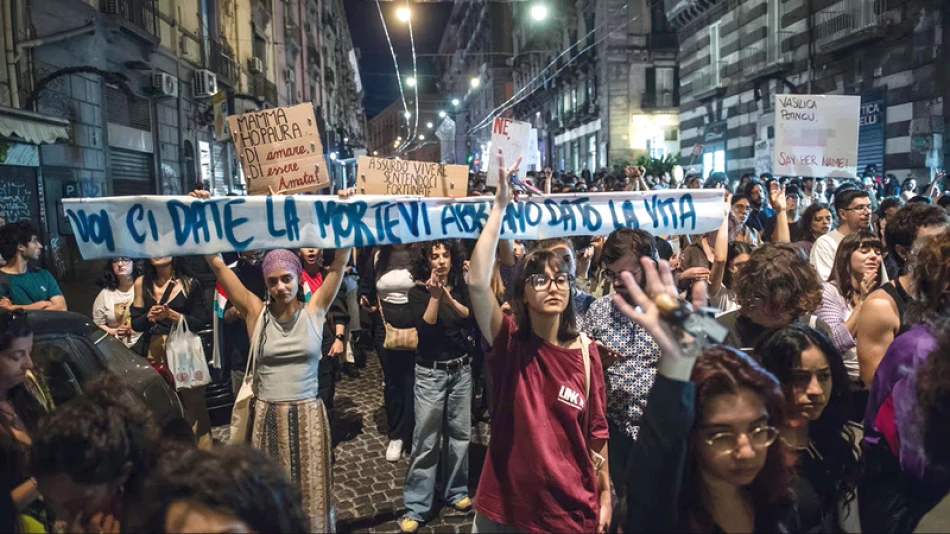
Gennini became the 72nd woman killed in Italy since the start of 2024, according to the "Non Una Di Meno" observatory that tracks these cases. Most of these murders are committed by current or former partners. Since Gennini's death, four more women have been killed, including 62-year-old Luciana Ronchi and 80-year-old Vanda Venditi. Six other cases are being reviewed as potential femicides.
The numbers tell a grim story. Last year, 116 women were murdered in Italy - similar to the figures from 2022 and 2023. This consistency is troubling because it suggests the problem isn't getting better despite increased attention.
Three years into Giorgia Meloni's tenure as Italy's first female prime minister, critics are asking whether she's done enough to address violence against women and workplace inequality. The statistics paint a challenging picture. Italy's birth rate dropped 6.3% in the first seven months of 2024 compared to the same period in 2023. Some Italian women still earn up to 40% less than men in the same jobs.
Meloni's government has passed legislation making domestic violence an aggravating factor in sentencing, meaning convicted perpetrators can face longer prison terms, including life sentences in some cases. The government also strengthened anti-stalking laws. But many say these measures don't go far enough, especially from Italy's first female leader.
Meloni rejects criticism that she's failed women. In previous statements, she's called such accusations "ridiculous," arguing that as a woman herself, she defends traditional family values. In a TikTok video, she dismissed criticism as "fake news," pointing to her government's promises to expand parental rights and provide tax breaks for families based on the number of children they have.
But here's the problem: Italy remains one of the few European countries without mandatory sex education in public schools. Women face increasing difficulties with employment equality, economic independence, and the ability to start families. The country's already low birth rate fell to 1.18 children per woman last year - the 16th consecutive annual decline. In the first seven months of 2024, it dropped further to 1.13, according to Italy's National Institute of Statistics.
Some blame Italian women for not having children. Meloni, who has long supported the traditional family model, has pushed for legislation criminalizing surrogacy and allowing abortion opponents access to clinics. In a 2023 event, she said many young women face social pressure to focus on their careers first, making childbearing a postponed choice.
Critics say she hasn't provided alternatives to help families bear the burden of childcare, despite campaign promises in 2022. For example, she proposed creating daycare centers but cut much of their budget after taking power.
A fertility report from Italy's National Statistics Institute identified several reasons for declining birth rates: fewer potential parents due to declining births since the 1970s, job insecurity, widespread temporary contracts, and low wages. All these factors significantly influence Italians' decision to have children.
According to the 2024 World Economic Forum report on gender gaps, Italy ranks 85th out of 148 countries in economic participation, opportunities, education, health, and political empowerment. Despite slight progress - rising two positions since Meloni's election - Italy remains among the lowest-ranked European countries for gender equality. It dropped to 117th place for women's economic participation, down six spots from the 2023 report.
Italian women hold divided views on Meloni's policies. Elly Schlein, leader of the Democratic Party and Italy's largest opposition party, is one of Meloni's harshest critics. In a recent TV appearance discussing new budget cuts proposed by Meloni's government, Schlein said: "Women are most affected. When you cut funding for social services, schools, and disability services, the care burden shifts to families, and therefore falls mainly on women."
But not all Italian women agree. Beatrice Costa feels happy having Meloni in power. Sitting in a Rome café with her six-month-old baby while her three-year-old attends government daycare, Costa told CNN: "I feel like I got permission to be a mother." She explained growing up under pressure to choose career over family, or at least start her career before thinking about having children. She said the pressure from not having children is intense, while it's difficult to resist the opposing pressure related to working outside the home and giving up the dream of starting a family.
Costa, who has a communications degree, had her first child before Meloni's election. "I don't know if the decision to have a second child resulted from Meloni's focus on the traditional family concept, or if we would have done it anyway, but I'm happy I have the ability to be a mother," she said. Her husband works as a successful tax accountant, and her parents provide significant support in childcare, helping the couple afford a family home.
Ariana Ricci, a 32-year-old HR manager, voted for Meloni's "Brothers of Italy" party in 2022, hoping she would prioritize addressing wage gaps, reproductive rights, and women's safety. But she says her hopes have been disappointed.
Ricci - who graduated from the prestigious Bocconi University in Milan and studied abroad - wants to stay in Italy, succeed in her homeland, start a family, and own her own home. While finding work seems easy in theory, she falls into the "precarious" job category, suffering from the absence of permanent contracts that provide job stability and basic benefits. She works under temporary contracts that don't guarantee job security.
"If I wanted to start a family while on a temporary contract, I wouldn't get paid maternity leave, I wouldn't get my job back after giving birth, and I couldn't cover childcare costs, even if I had a job to return to," Ricci says. "Where's the incentive to start a family then?"