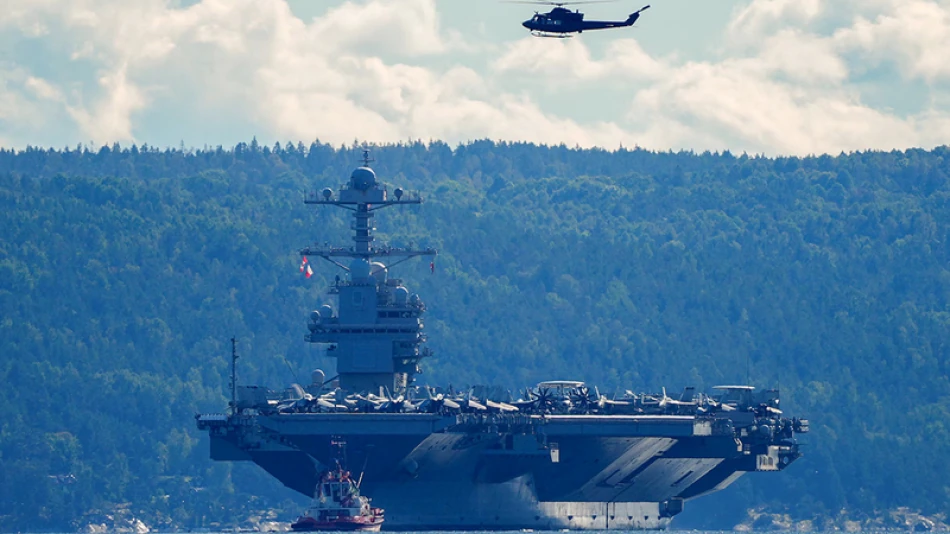
US Sends Flagship Carrier 'Ford' to Caribbean, Escalating Tensions with Venezuela
 Sara Khaled
The USS Gerald R. Ford, America's most advanced aircraft carrier, has arrived near Venezuelan waters in what military analysts see as a major escalation of pressure against President Nicolás Maduro's government. The deployment signals Washington's readiness to demonstrate overwhelming force and could pave the way for military action or a comprehensive naval blockade in the Caribbean.
Military analyst Brandon Weichert told National Interest magazine that the Ford isn't just another carrier in a potential conflict with Venezuela. It represents a massive force multiplier that significantly boosts U.S. naval capabilities off the Latin American nation's coast.
The Trump administration sent the carrier as a clear power message and to ensure maximum success if the White House decides to move forward with proposed attacks on Venezuela. But here's the thing - the Ford comes with some technical baggage that could matter in actual combat.
The Pentagon insisted on cramming 23 new technologies into the Ford all at once, including the crucial Electromagnetic Aircraft Launch System (EMALS) and Advanced Arresting Gear (AAG). Most of these systems have had performance issues since installation.
Pentagon sources confirm Americans got the EMALS system working, but defense publications note it's still not completely reliable by the Navy's strict standards. The system has improved since its initial installation, yet questions remain about its dependability under pressure.
Despite these concerns, the Ford has conducted full flight operations using EMALS in real conditions, including continuous flight operations in the North Sea and Mediterranean. In 2022, both EMALS and AAG systems set records for takeoffs and landings aboard the ship, showing the crew has adapted well to the technology.
But here's what matters most - the Ford has never been tested in the kind of combat scenario it would face if Trump decides to attack Maduro's regime. The EMALS system is designed to let the carrier launch about 25% more daily sorties than a Nimitz-class carrier with fewer crew members.
In practical terms, this means more strike packages, significantly increased air combat patrols, and greater presence of intelligence, surveillance, reconnaissance, and electronic warfare aircraft in the air at any given time.
Compared to other ships in the current U.S. Caribbean deployment off Venezuela's coast, the Ford offers much greater offensive capability - assuming the Venezuelans can't score one or two "lucky" hits on the ship with their anti-ship missiles.
Venezuela's air force and air defense network are limited in size and modernization compared to U.S. capabilities. A Ford-led battle group should give Americans decisive superiority. The carrier can deploy continuous air combat patrols over the Caribbean and near Venezuelan airspace using Super Hornet fighters supported by E-2D aircraft.
The Ford can also deploy Growler aircraft and precision munitions to strike Venezuelan radars, surface-to-air missile sites, and command and control centers. For traders watching regional markets, any military escalation could disrupt oil flows from one of the world's largest petroleum reserves, potentially affecting global energy prices and regional stability for months.