UAE's Humanitarian and Diplomatic Commitment to Sudan: Fostering Stability and Cooperation
 Sara Khaled
The UAE continues to maintain its firm stance on Sudan's civil war that erupted in April 2023, combining strong condemnation of serious violations with calls for an immediate ceasefire and a civilian-led political solution. The country has provided nearly $3.9 billion in aid to Sudan from 2014 to 2025, while pushing for international action to protect civilians caught in the crossfire.
Since the early days of the crisis, the UAE has issued official statements calling for civilian protection and an end to attacks on residential areas. The country has repeatedly urged the international community to take responsibility for the documented crimes and violations happening daily in Sudan.
In June 2024, the UAE condemned attacks against civilians in Al-Fashir, calling them "a dangerous escalation and blatant violation of international humanitarian law." The country demanded humanitarian corridors and urgent civilian protection. More recently, in February 2025, the UAE denounced UN reports revealing the use of chemical weapons in western Darfur, stating that using such weapons against civilians constitutes a war crime that cannot be ignored.
The UAE has made it clear that indiscriminate bombing, field executions, sexual violence, blocking humanitarian aid, and cutting off supplies to civilians must stop immediately. The country insists that those responsible must be held accountable.
All parties involved in the conflict share responsibility for the atrocities committed since the war began, according to the UAE's position. The country argues that continued military operations will only prolong suffering and deepen the humanitarian crisis. During an official intervention at the Human Rights Council in March 2025, the UAE called for an end to violations against women and children and demanded comprehensive civilian protection under international humanitarian law.
The UAE believes a political path is the only way to end the crisis. From its participation in Jeddah talks in May 2023, through meetings in Manama in June 2024, Geneva in October 2024, and Washington in July 2025, the country has called for a comprehensive political solution that puts the Sudanese people's interests above those of warring parties.
The country supports launching a civilian-led transitional process, away from armed and extremist forces, aimed at forming a civilian government within nine months. This government would have the legitimacy and capacity to restore state institutions and maintain the country's stability.
In September 2025, the UAE welcomed a statement from the "Quartet" (UAE, Saudi Arabia, United States, and Egypt), considering it an important breakthrough and turning point toward relaunching the political process. The country announced its support for the statement as part of its commitment to reducing Sudanese suffering and stopping escalation.
The UAE has pushed for a three-month humanitarian truce, an initiative announced in April 2025, to open safe corridors for humanitarian aid. UN reports indicate 25 million people inside Sudan need urgent assistance, including more than 4.5 million displaced since the war began. The UAE views this truce as necessary preparation for a permanent ceasefire that would allow for a comprehensive and transparent political process.
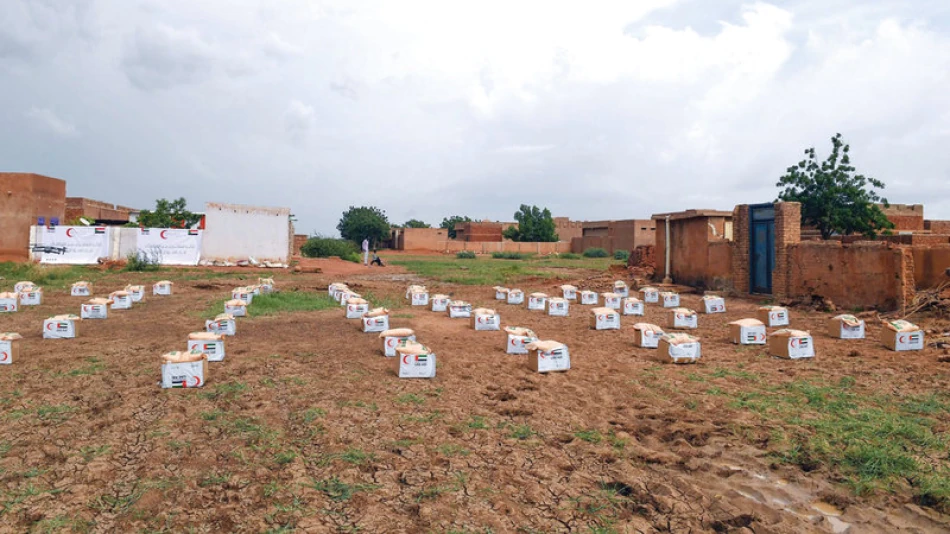
Beyond diplomatic statements, the UAE has provided direct support through massive humanitarian and development aid. From May 2023 to December 2024, the country sent more than 122 cargo planes to Port Sudan and Darfur, carrying a total of 8,300 tons of food, medical supplies, and shelter materials.
Healthcare has been a major focus of UAE support for Sudan. The country built two field hospitals in Amdjaras and Abeche in Chad to provide medical services for Sudanese refugees in neighboring countries. It also opened a hospital in the Madol area of Bahr al-Ghazal state in South Sudan and provided support to more than 127 health facilities across 14 states.
The UAE has provided direct assistance to more than 650,000 people inside Sudan, including electricity generators for damaged hospitals, rehabilitation of water centers, and food supplies for about 180,000 families. In November 2024, the country launched an emergency campaign to provide 100,000 food baskets to residents of Gezira and Kassala states through an airlift that included 14 flights in one week.
The UAE has repeatedly emphasized that its support for the Sudanese people isn't tied only to the current conflict but comes as part of a long-term humanitarian commitment to Sudan. The country participated in reconstruction efforts and development projects before the war broke out, including supporting education, health, and infrastructure programs between 2016 and 2022.
Facing media disinformation campaigns that have accompanied the Sudanese conflict since mid-2024, the UAE expressed concern about attempts to distort facts and divert attention from humanitarian and diplomatic efforts. In an official statement in September 2025, the country said media disinformation prolongs war and increases civilian suffering. It called for confronting hate speech and misleading propaganda while supporting responsible media that reports facts and contributes to peace efforts.
The UAE has warned about the growing danger of extremist and terrorist groups inside Sudan. At an international security meeting in July 2025, the country noted that the spread of these groups poses a direct threat to regional stability and called for international cooperation to contain terrorism sources and prevent their expansion.
These consistent positions reflect a clear UAE vision based on supporting the Sudanese people, rejecting war, protecting civilians, and pushing toward sustainable political solutions. The country continues working with the international community to ensure a ceasefire, facilitate humanitarian aid access, and strengthen the civilian-led transitional path to help Sudan overcome one of its most complex crises in modern history.