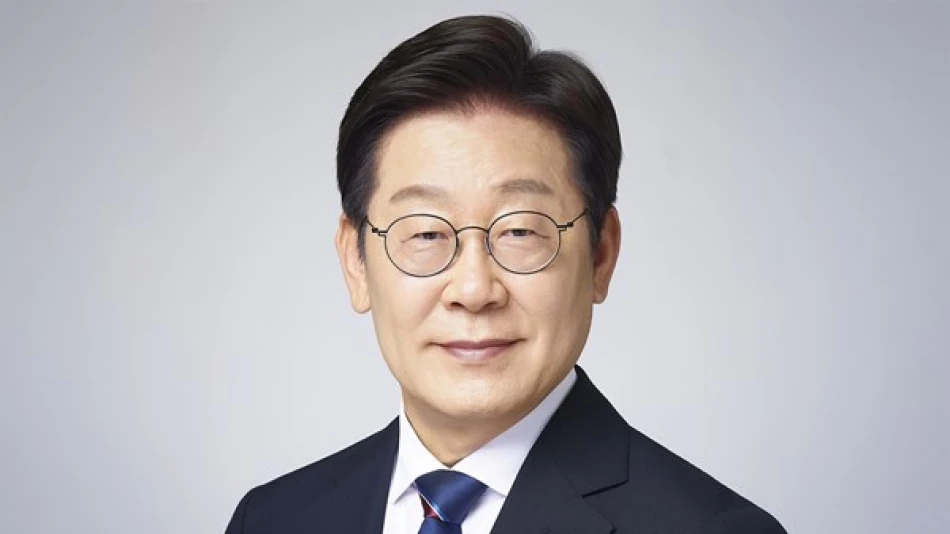
South Korean President Highlights Shared Trust and Commitment in UAE Partnership
 Layla Al Mansoori
South Korea's President Lee Jae-myung says his country's relationship with the UAE has grown far beyond basic economic cooperation into a "comprehensive special partnership" built on trust and shared goals. Speaking during his first Middle East visit since taking office in June, Lee chose the UAE as his opening destination to signal Korea's commitment to deepening ties with what he calls the country's only strategic partner in the region.
The partnership centers on the UAE's $30 billion investment commitment to Korea announced in 2023, which Lee describes as a strategic decision that goes well beyond typical economic cooperation. This investment has already sparked active participation from Emirati institutions like Mubadala, which are targeting Korean companies with advanced technology, particularly in AI and other industries both countries consider strategically important.
Nuclear Energy Success Opens New Doors
The Barakah Nuclear Power Plant stands as the partnership's flagship achievement. After 12 years of construction, the facility reached full commercial operation in September 2024, becoming the Middle East's first commercial nuclear plant. The four Korean-built reactors now supply 25% of the UAE's electricity needs.
Lee sees this success as the foundation for expanded nuclear cooperation. Korea plans to work with the UAE on next-generation nuclear technology, including small modular reactors - a market expected to reach $670 billion globally by 2050. The countries also aim to jointly enter third-country nuclear markets, building on Korea's development of small modular reactor technology and its domestic pilot reactor project.
The nuclear partnership extends to renewable energy. Korean companies already participate in major UAE projects, including the 1.5-gigawatt Al Ajban Solar Power Plant through Korea West Power, and joint renewable projects in third countries between Korea Central Power and Masdar.
AI and Semiconductor Ambitions
Korea positions itself as a crucial partner for the UAE's AI strategy, which aims to make the country a global AI hub by 2031. Lee points to Korea's dominance in memory chip production as key to supplying the advanced AI semiconductors the UAE needs for its ambitious plans.
Recent cooperation between companies like OpenAI and Korean semiconductor firms demonstrates Korea's essential role in AI infrastructure development. Lee expects Korean companies to play major roles in building the UAE's AI semiconductor ecosystem, while emerging Korean AI companies like Rebellions and FuriosaAI could serve as alternative suppliers in a market currently dominated by few players.
Korea's strengths span the entire semiconductor supply chain - materials, components, equipment, and R&D - giving it the capability to meet the UAE's needs for developing its semiconductor ecosystem and boosting competitiveness in advanced industries.
Space Cooperation Reaches New Heights
The UAE has established itself as a rising space power in the Middle East, successfully operating the Hope Mars probe. The partnership with Korea began with the development of DubaiSat, the UAE's first satellite, created through Korean collaboration. Emirati personnel continue receiving space development training at Korea's Advanced Institute of Science and Technology (KAIST).
Future space cooperation will expand across three main areas: joint satellite development and utilization, ground infrastructure including launch platforms and satellite navigation ground stations, and space exploration extending from the Moon to Mars.
Trade and Cultural Exchange
The UAE serves as Korea's top Middle East travel destination, hosting about 200,000 Korean visitors annually. A 2016 visa waiver agreement allows citizens of both countries to visit freely for 90 days, creating the foundation for expanded human exchanges including tourism, cultural activities, and business visits.
Korea plans to establish a new Korean center in the UAE by 2030, developing it as a central facility for cultural exchange and trade between the countries. The government will also work to improve entry procedures for UAE citizens visiting Korea and expand cultural exchanges to include related industries like beauty and food through the existing Korea 360 center in Dubai.
The Comprehensive Economic Partnership Agreement (CEPA) between the countries eliminates tariffs on over 90% of traded goods, including Korean electric and hybrid vehicles and UAE petrochemical products. This should expand bilateral trade while boosting industrial competitiveness and benefiting consumers in both countries.
Crisis-Tested Partnership
The relationship has proven resilient during crises. During the COVID-19 pandemic, Korea supplied the UAE with health protection equipment. When Korea faced a liquid urea shortage, the UAE provided alternative supplies. These experiences demonstrate how combining Korea's technological capabilities and manufacturing base with the UAE's energy and logistics capabilities can create stable supply chains.
Lee emphasizes that this cooperation model - leveraging each country's strengths - represents more than a one-time response but a new framework for crisis management. The countries plan to build a permanent, structural cooperation system based on these successful experiences.
Both countries also collaborate on climate finance initiatives. Korea hosts international climate organizations like the Green Climate Fund and Global Green Growth Institute, while the UAE established the Global Climate Finance Centre after hosting COP28 in 2023. Their combined technological and financial capabilities position them to make significant contributions to international climate crisis responses.
For Korea, the UAE represents its sole special strategic partner in the Middle East - a relationship built on the UAE's confidence in Korean technology and safety through importing four Korean nuclear reactors, and Korea's commitment demonstrated by deploying 4,000 personnel to the UAE over 15 years. As Lee puts it, both countries work as genuine partners who respect each other's security and design their shared future together.