Fears Grow as Gaza Strip Faces Looming De Facto Division
 Layla Al Mansoori
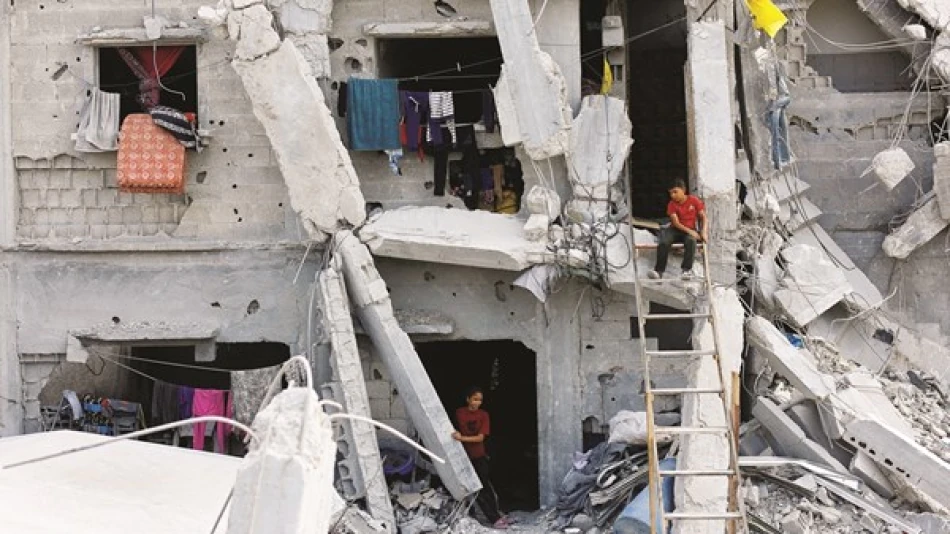
Gaza faces the growing possibility of a de facto partition, with Israel controlling one zone and Hamas governing another, as Trump's peace plan stalls beyond the first phase of the ceasefire. Six European officials directly involved in implementation efforts say the plan has effectively stopped, and reconstruction will likely be limited to Israeli-controlled areas only.
The current situation leaves Gaza divided by what's known as the "yellow line" - a boundary that could become permanent without major shifts from Hamas, Israel, or significant US pressure on Israel to accept Palestinian Authority involvement and a path toward Palestinian statehood.
Under the first phase of the plan that began in October, Israeli forces now control 53% of Gaza, including most agricultural land, Rafah in the south, and parts of Gaza City and other urban areas. This control gives Israel significant leverage over any reconstruction efforts and humanitarian aid distribution.
The US has drafted a UN Security Council resolution that would give a multinational force and transitional governing body a two-year mandate. But 10 diplomats report that governments remain hesitant to commit troops to such a deployment. The reluctance stems from security concerns and the unclear political framework for long-term governance.
Some creative solutions are being discussed behind closed doors. Two European officials and a Western diplomat revealed that one idea involves Hamas surrendering weapons under international supervision rather than handing them directly to Israel or another foreign power. This could provide Hamas with a face-saving exit while addressing Israeli security concerns.
Egypt is playing a key diplomatic role in these discussions. Foreign Minister Badr Abdelati said yesterday that several countries have raised concerns about the UN resolution draft for deploying international forces in Gaza. Egypt is consulting daily with Washington and working with all Security Council members and the Arab Group to find compromise language.
The Egyptian foreign minister expressed hope for reaching "consensus formulations" that preserve Palestinian principles while allowing international forces to deploy quickly. But the challenge remains making any resolution actually workable on the ground.
Here's what makes this situation particularly complex: neither side appears willing to make the concessions needed for the second phase of Trump's plan. Hamas wants to maintain some control over Gaza, while Israel seeks security guarantees that would effectively limit Palestinian sovereignty. Meanwhile, the Palestinian Authority remains largely sidelined from these discussions.
For regional stability, a prolonged partition could create new problems. It would likely cement Hamas's control over part of Gaza while giving Israel permanent security control over strategic areas. This arrangement might provide short-term quiet but could store up bigger conflicts for the future.
The international community faces a difficult choice. Supporting reconstruction only in Israeli-controlled areas might encourage the partition, but refusing aid could leave Gaza's population in continued hardship. European officials warn this division could last for years without breakthrough diplomacy.
Egypt continues pushing hard for entry into the second phase of the ceasefire agreement, but the political obstacles remain substantial. The coming weeks will likely determine whether Gaza moves toward some form of unified governance or settles into a long-term divided reality.