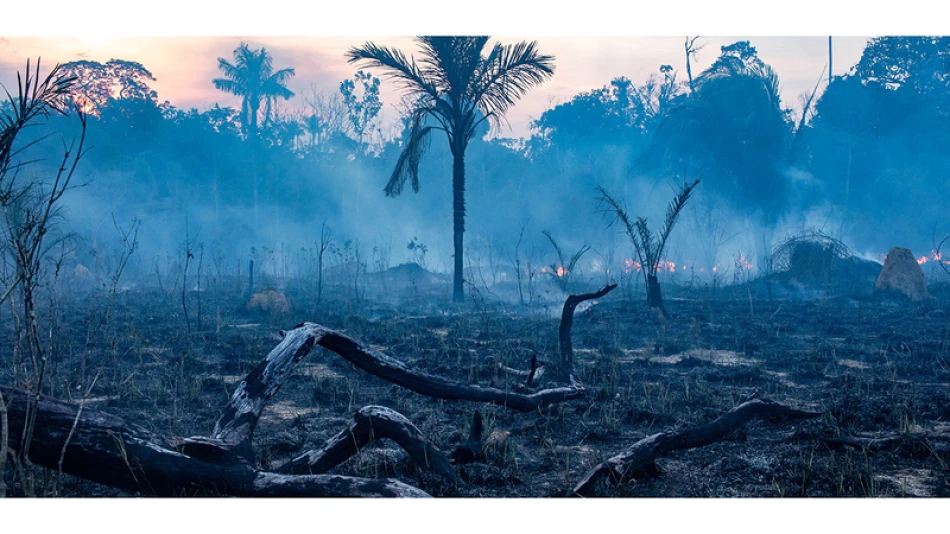
Earth's Forests Shift from Climate Change Ally to Part of the Problem
 Sara Khaled
Africa's forests have flipped from absorbing carbon dioxide to producing it, according to new research from UK universities Leicester and Sheffield. This alarming shift since 2010 means all three major forest regions on Earth - the Amazon, Southeast Asian forests, and Africa - are now contributing to climate change instead of fighting it.
The study, published in Scientific Reports, reveals a stark reality. Between 2010 and 2017, African forests lost about 106 billion kilograms of biomass annually - equivalent to the weight of 106 million cars. The worst hit areas were the broad-leafed tropical rainforests in Democratic Republic of Congo, Madagascar, and parts of West Africa.
Human activities drive this crisis. Farmers cut down more trees to clear land for food crops. Infrastructure projects, mining operations, and fires make things worse. All of this destroys the planet's natural ability to absorb carbon from the atmosphere through the green leaves of forest plants.
Using satellite data and machine learning, researchers tracked nearly a decade of changes in carbon stored in trees and woody plants. They found African forests actually gained carbon between 2007 and 2010. But widespread forest loss since then tipped the balance. Now the continent pumps more carbon dioxide into the atmosphere instead of pulling it out.
The researchers warn that urgent action is needed to stop forest loss, or the world risks losing one of its most important natural carbon barriers. Their findings show how global temperatures keep rising from burning oil, gas, and coal while the planet's natural defense systems break down.
Brazil launched the "Tropical Forest Forever Facility" to address this crisis. The initiative aims to raise $100 billion to protect forests from being cleared for agriculture. The plan involves paying countries to stop cutting down their forests and converting them to farmland. But so far, only a few countries have donated money. The initiative has raised just $6.5 billion.
Professor Heiko Balzter, who leads the Future Environment Institute at Leicester University, says the study shows how critical it is to expand this forest protection initiative quickly. "The Earth faces environmental problems that reach the level of destruction and loss of life," he explains.
At the COP26 climate conference in Glasgow, world leaders promised to end global deforestation by 2030. But progress isn't happening fast enough for scientists and researchers. The new forest fund aims to pay forested countries to keep their tree roots in the ground. This gives governments and private investors a way to counter the economic drivers of deforestation, like mining for minerals and metals, and agricultural land use.
But countries need to contribute much more money to make it work. The fund represents a direct approach to one of climate change's biggest challenges - keeping the world's remaining forests intact so they can continue absorbing carbon instead of releasing it.