UAE's Sustainable Transformation: From Desert to Green Leadership
 Layla Al Mansoori
The UAE has transformed from a resource-scarce desert nation into a global model for balancing economic growth with environmental protection in less than 50 years. Building on Sheikh Zayed's foundational vision that "the environment is not owned by one generation but is a trust for future generations," the country now leads international climate action while developing a low-carbon economy.
From Vision to National Strategy
Mohammed Saeed Al Nuaimi, Undersecretary at the Ministry of Climate Change and Environment, explains that the UAE continues cementing its position as a global leader in environmental protection through an integrated national vision. "Environmental protection and climate action have become essential parts of economic and social development plans," he says. "Today, we don't view sustainability as just an environmental commitment, but as a tool for achieving economic, social, and food security."
The UAE's Net Zero 2050 strategy goes beyond emissions reduction. It's a comprehensive national program transforming climate challenges into new development opportunities across six key sectors: energy, industry, transport, agriculture, buildings, and waste management. The National Green Agenda 2030 provides the long-term framework for transitioning to a knowledge and innovation-based green economy.
Agriculture and Food Security at the Forefront
Agriculture represents a cornerstone of the UAE's climate response and sustainable food security efforts. The ministry launched the National Agricultural Center last year as a specialized platform for agricultural research and innovation. This facility enhances local production of strategic crops while reducing import dependence and supporting Emirati farmers with training programs and climate-smart technologies.
The fisheries sector receives equal attention as a vital component of national food security and Emirati heritage. The country develops sustainable fishing practices that preserve fish stocks for future generations while expanding modern aquaculture projects. These measures form part of a comprehensive national food security strategy aimed at building a resilient food system adaptable to climate changes.
Air quality remains a national priority as a foundation for quality of life and sustainable development. The National Air Quality Agenda 2031 provides the strategic framework unifying national efforts through partnerships between government entities, private sector, and academia.
Nature-Based Solutions and Global Leadership
Dr. Shaikha Salem Al Dhaheri, Secretary General of the Environment Authority - Abu Dhabi, highlights how hosting the IUCN World Conservation Congress positioned Abu Dhabi as a pivotal player in global nature conservation. "These conferences provided a platform to showcase the UAE's experience in nature-based solutions for climate change," she says.
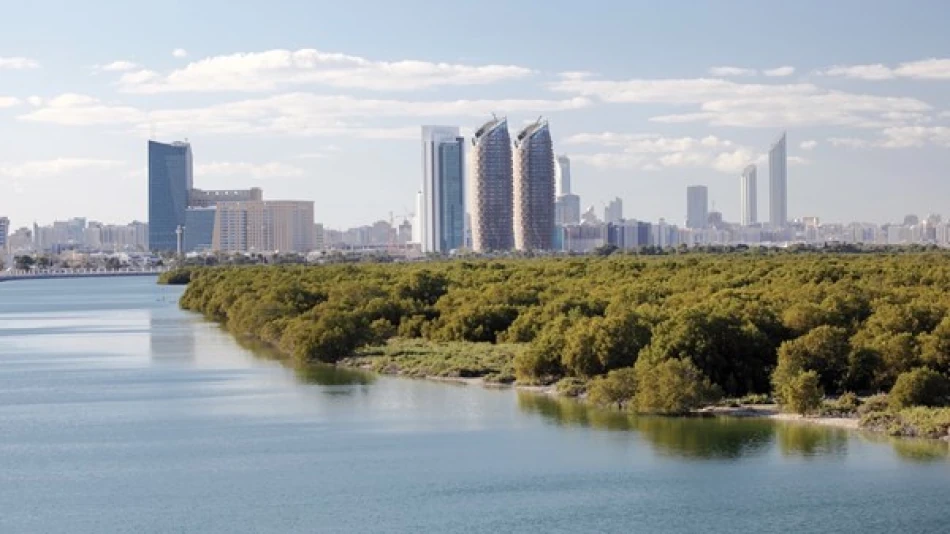
The UAE has already planted over 50 million mangrove trees using advanced technologies including drones and precise location mapping, working toward its goal of 100 million trees by 2030. This effort reflects the country's commitment to nature-based solutions, exemplified by the "Mangrove Alliance for Climate" launched with Indonesia, now comprising over 45 countries focused on enhancing coastal ecosystems' role in carbon absorption and marine biodiversity protection.
International Impact and Investment
The UAE's leadership extends beyond its borders through cross-border initiatives like the Mohammed bin Zayed Water Initiative, the Clean Rivers Foundation, and the Alterra Fund announced during COP28, which targets mobilizing $250 billion for climate solutions investments. Hosting major global conferences like COP28 and participating in the UN Water Conference positions the UAE as an international dialogue platform bringing together experts and decision-makers.
International experts recognize the UAE's approach as a replicable global model. Liz Pigeon from Heart Fullness notes: "The technical innovation the UAE employs in its environmental projects, such as using artificial intelligence and drones in mangrove planting and habitat restoration, makes the country a key player in the future of global environmental action."
Liliana Jorgie from the IUCN Netherlands Committee confirms that the UAE has become an influential global platform in shaping the future of environmental action through effective policies and hosting international conferences, enhancing its ability to protect endangered species and combat environmental degradation.
Clean Energy and Economic Transformation
The UAE leads the world in clean energy adoption while maintaining economic growth. Al Nuaimi points to massive renewable energy projects like the Mohammed bin Rashid Solar Park and Masdar's global projects, alongside peaceful nuclear energy development at Barakah. "Our national strategies demonstrate that economic growth and climate action go hand in hand, transforming environmental challenges into innovative development opportunities," he explains.
These efforts operate within comprehensive frameworks like the National Green Agenda 2030, providing a long-term roadmap for sustainable development and economic transformation. The agenda follows five strategic paths including clean energy enhancement, climate change adaptation, competitive knowledge economy development, and ensuring sustainable environment and natural resource value.
Scientific Research and AI Integration
Professor Rabee Rustom from Heriot-Watt University Dubai emphasizes how the UAE transformed Sheikh Zayed's legacy into an integrated institutional system based on scientific research and sustainable policies. "Integrating carbon neutrality goals within the UAE's Net Zero 2050 strategy reflects a strategic direction linking economic growth with evidence-based policies," he says.
Advanced technologies support biodiversity management in concrete ways. Deep learning algorithms and satellite data analytics monitor mangrove forest reproduction, showing expansion exceeding 9,000 hectares by 2024, with improved carbon stock calculations using advanced AI models. These efforts represent a successful model integrating technology and scientific research to support effective ecosystem management.
Dr. Al Dhaheri confirms that innovation and technology form the backbone of success in this path. Integrating artificial intelligence, drones, and big data analysis in ecosystem management exemplifies how the UAE employs modern technologies to serve the environment. Projects like planting 100 million mangrove trees, half implemented using aircraft for precise location identification, reflect the country's commitment to nature and technology-based solutions.
The UAE's integrated approach combines technological innovation, scientific research, national policies, and international and community partnerships. This proves that economic development and environmental sustainability can proceed together, and that protecting nature isn't optional but a fundamental pillar in the country's strategy for building a sustainable and secure future for coming generations.