UAE Foreign Minister Abdullah bin Zayed Holds Telephone Talks with US Secretary of State
 Layla Al Mansoori
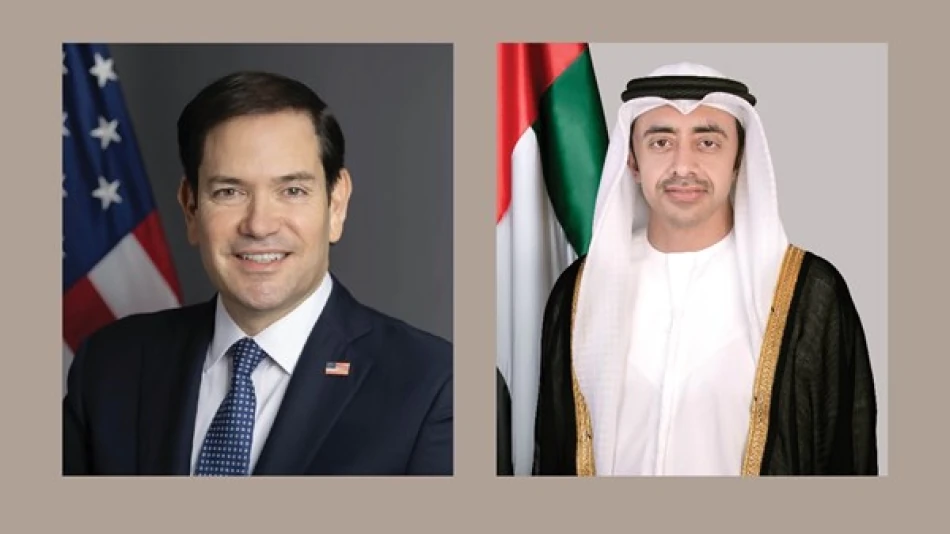
The UAE and US foreign ministers held talks covering two major regional crises and a significant tech partnership deal. Sheikh Abdullah bin Zayed Al Nahyan spoke with US Secretary of State Marco Rubio about the ongoing wars in Sudan and Gaza, while also thanking President Trump for allowing advanced AI chip exports to UAE's G42 company.
The phone call focused heavily on Sudan's civil war, which has been raging for over two years. Both officials agreed on the need for an immediate, unconditional ceasefire and unhindered humanitarian aid delivery to civilians. Sheikh Abdullah welcomed Trump's recent statements condemning the attacks on civilians and his efforts to bring stability to Sudan.
The ministers also discussed Gaza and the establishment of a "Peace Council" following the UN Security Council's adoption of Resolution 2803, which was proposed by the United States. Sheikh Abdullah emphasized support for Trump's comprehensive plan to end the Gaza conflict, aiming for long-term security, stability, and prosperity across the region.
But the conversation also covered a major tech development. Sheikh Abdullah specifically called to thank Trump for the White House decision to allow exports of advanced AI semiconductors to G42, a prominent UAE artificial intelligence company. This move signals deepening US-UAE cooperation in cutting-edge technology sectors.
The semiconductor export approval is significant for several reasons. G42 has been positioning itself as a major player in AI development across the Middle East and beyond. Access to advanced US chips gives the company a competitive edge in building AI infrastructure and services. For the UAE, this represents validation of its strategy to become a regional tech hub.
The decision also reflects the broader US-UAE strategic partnership, which spans defense, energy, and now advanced technology. As countries worldwide compete for AI leadership, access to top-tier semiconductors has become a key diplomatic and economic tool.
The timing of these discussions comes as the new Trump administration shapes its foreign policy approach toward the Middle East. The focus on both conflict resolution and technology cooperation suggests the US sees the UAE as a key partner for regional stability and economic innovation.