UAE Food Bank Celebrates Strategic Partners, Shareholders, and Volunteers at Annual Gala
 Sara Khaled
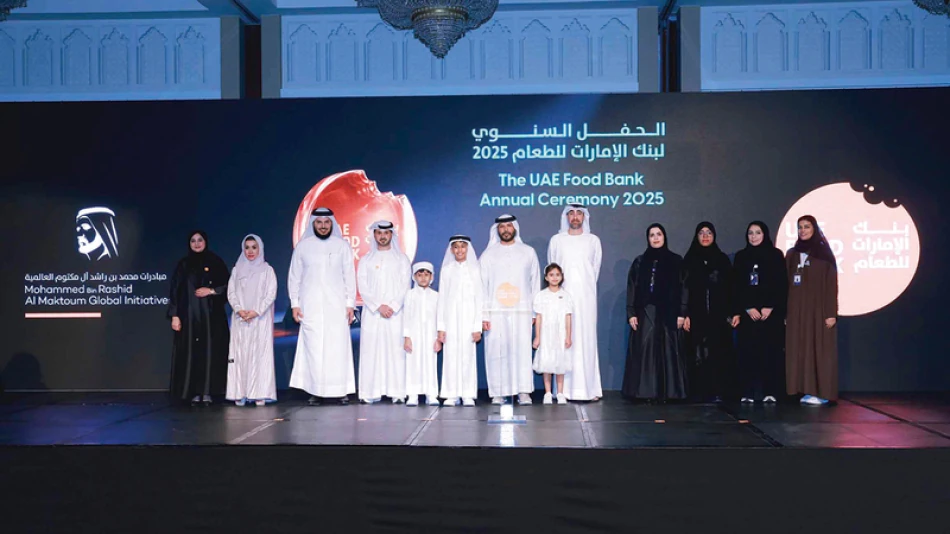
The UAE Food Bank celebrated its 2025 annual ceremony in Dubai, honoring 67 organizations that helped the institution serve over 23 million people with surplus food meals and divert more than 6,275 tons of food waste from landfills. The event highlighted how strategic partnerships have enabled the food bank to distribute over 100 million meals since its founding.
The ceremony took place at Jumeirah, Dubai, under the patronage of Her Highness Sheikha Hind bint Maktoum bin Juma Al Maktoum, Chairman of the Board of Trustees and Supreme President of the UAE Food Bank. The event brought together government representatives, private sector partners, volunteer teams, and supporting institutions.
Among those honored were 37 organizations that received the charitable endowment mark, along with donors from various sectors, individual and institutional volunteers, former corporate teams, and influencers who helped spread the bank's message. This recognition reflects the bank's commitment to building a culture of giving and sustainability through meaningful partnerships.
Engineer Marwan Ahmed bin Ghalita, Deputy Chairman of the UAE Food Bank's Board of Trustees, emphasized that the bank's achievements directly reflect the UAE's approach to humanitarian work. "The close cooperation between partners and volunteers has enabled the bank to expand its operations and achieve tangible results, both in delivering food to those who deserve it and in reducing waste while supporting environmental sustainability," he said.
The numbers tell a compelling story. In 2025 alone, the food bank received donations worth approximately 1.1 million dirhams and conducted educational programs that reached over two million people. The organization implemented 20 initiatives and activities as part of its annual work plan, with extensive participation from volunteers and donors.
The bank also signed 28 cooperation agreements with local, regional, and international entities to expand its network and enhance its ability to reach communities in need. These partnerships have been crucial in scaling operations beyond the UAE's borders.
From an environmental perspective, the achievement of diverting over 6,275 tons of surplus food from landfills represents more than 15 million meals saved. This directly supports national sustainability efforts by reducing carbon emissions and fighting food waste - a growing global concern as food security becomes increasingly important.
Manal bin Yaroof, Head of the Executive Team at UAE Food Bank, highlighted how partner and volunteer support forms the core of the bank's success. "We have focused during 2025 on enhancing the efficiency of food preservation and distribution operations, and expanding our cooperation network with various entities to ensure food reaches those who deserve it in a safe and sustainable way," she explained.
The food bank's model demonstrates how public-private partnerships can address both social needs and environmental challenges simultaneously. By connecting food suppliers with distribution networks and volunteer teams, the organization has created a system that tackles hunger while reducing waste.
The ceremony concluded with the announcement of strategic partners, supporting entities, and volunteer teams that played central roles in enhancing the bank's presence and implementing its programs. Officials emphasized continued collaboration to expand the bank's humanitarian impact in the coming years.
This initiative comes as the UAE positions itself as a regional hub for humanitarian work and sustainability efforts. The food bank's growth reflects broader national priorities around food security, environmental responsibility, and social solidarity that have become increasingly important in the region's development strategy.