North Korea Bolsters Russia's Invasion of Ukraine with Robust Support
 Sara Khaled
North Korea has become Russia's most important military partner in the Ukraine war, sending up to 15,000 soldiers and millions of artillery shells while gaining valuable combat experience and advanced weapons technology in return. This partnership is reshaping military dynamics on the Korean Peninsula and strengthening the anti-Western alliance led by China and Russia.
Heavy Casualties, Strategic Gains
Since fall 2024, Pyongyang has deployed between 14,000 and 15,000 troops to fight alongside Russian forces, according to Western officials. Most come from North Korea's elite special forces unit, the 11th Corps of the Korean People's Army, known as the "Storm Corps."
These forces have paid a steep price. More than 6,000 North Korean soldiers have been killed or wounded, according to Britain's Defense Ministry. But the deployment has given North Korea something invaluable: real combat experience in the world's most technologically advanced battlefield.
Ukrainian military reports show North Korean forces quickly adapted their tactics. They shifted from World War II-style light infantry attacks across open ground to sophisticated drone warfare. This forced Ukrainian troops to change their own approach, using drones to target North Korean soldiers and laying anti-personnel mines at closer intervals to slow their advance.
Massive Arms Shipments
North Korea started helping Russia long before sending troops. The first weapons shipment arrived in August 2023, when both Russian and Ukrainian armies were running low on ammunition.
South Korea's Defense Intelligence Agency estimates North Korea has sent more than 12 million artillery shells to Russia. Some Russian units now rely almost exclusively on North Korean-made artillery rounds, which represents roughly half of Russia's artillery supply.
The weapons range from short-range ballistic missiles capable of carrying nuclear warheads to self-propelled guns and multiple rocket launch systems. Russia and North Korea have also signed agreements for Pyongyang to produce drones that Russia uses to target civilian areas.
Technology Transfer Payoff
Russia's support is helping North Korea modernize its military capabilities at an unprecedented pace. In exchange for weapons and troops, Russia has provided air defense equipment, anti-aircraft missiles, and advanced electronic warfare systems.
The improvement is measurable. Nearly half of North Korea's ballistic missiles in the initial shipment went off course and exploded in mid-air. Now their accuracy has improved significantly, thanks to battlefield data sharing from Russia.
Kim Jong Un has showcased new military technology in recent months, including launching the country's largest naval destroyer in April 2025 and testing a hypersonic cruise missile that experts say resembles a Russian model capable of carrying nuclear warheads.
Regional Security Implications
South Korea warns that deepening cooperation between Moscow and Pyongyang threatens to destabilize the military balance on the Korean Peninsula. Russia is also helping North Korea develop its space and nuclear programs, though the full extent remains unclear.
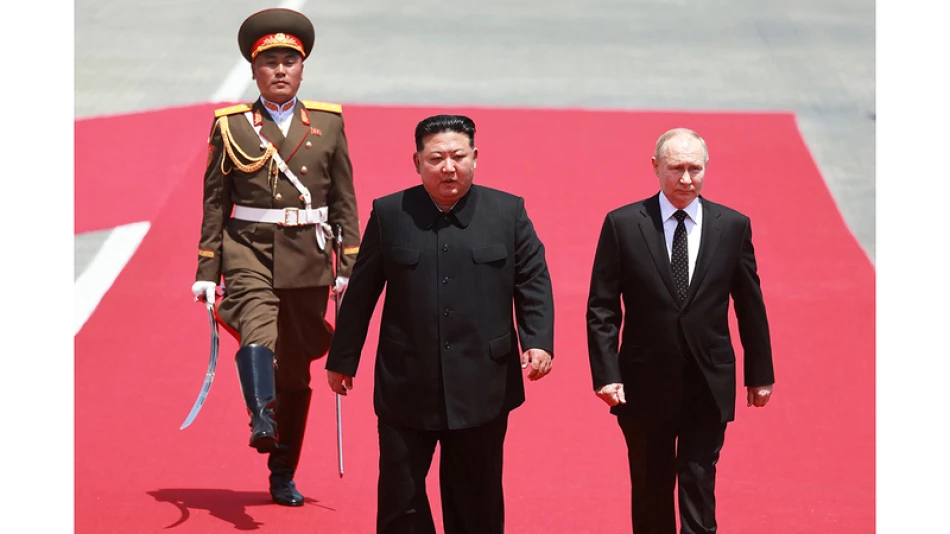
The partnership solidified with a comprehensive strategic partnership treaty signed by Kim and Putin in June 2024, which includes a mutual defense clause. This marks a significant shift from North Korea's previous isolation to becoming a key player in the Russia-China axis.
For investors and policymakers, this alliance signals a longer-term realignment of global military partnerships. North Korea's combat-tested forces and improved weapons systems will likely influence regional security calculations for years to come, particularly as tensions remain high on the Korean Peninsula.