Luminous Young Minds Honored by Latifa bint Mohammed at 'Dubai Future Solutions' Event
 Sara Khaled
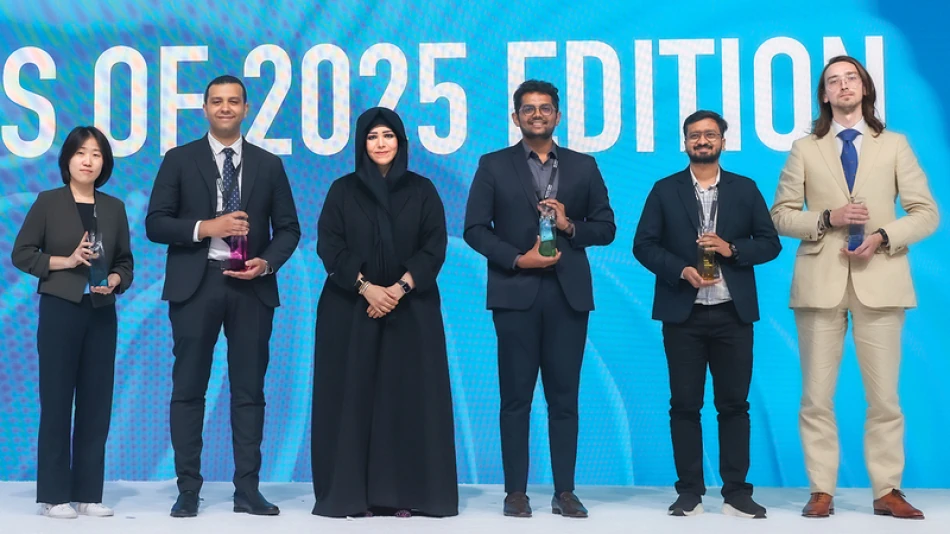
Dubai honored five talented students who won the "Dubai Future Solutions - Innovations for Humanity" 2025 initiative with a shared $100,000 prize. The ceremony took place during the fourth Dubai Future Forum, recognizing university innovations that tackle urgent global challenges in health, technology, environment, and social impact.
Sheikh Latifa bint Mohammed bin Rashid Al Maktoum, chairperson of Dubai Culture and Arts Authority, presented the awards under the guidance of Sheikh Hamdan bin Mohammed bin Rashid Al Maktoum, Dubai's Crown Prince. The winners were selected from 100 finalists who made it through a competition that drew thousands of ideas from students and professors at over 1,200 universities across 120 countries.
The initiative reflects growing global momentum for research and development focused on serving humanity. Here's what makes this particularly significant: Dubai is positioning itself as a global hub for innovation by connecting academic, government, and industry sectors under one shared vision.
**The Winning Innovations**
The competition covered five categories, each addressing critical global needs. From Oxford University, the "CASPR" project won in health diagnostics and treatments for developing precision gene therapy alongside a diagnostic platform to fight drug-resistant infections.
Harvard University's "VOCADIAN" took the urban communities category with an AI-powered voice analysis tool that detects worker fatigue to prevent accidents in high-risk sectors like construction. This technology could significantly reduce workplace injuries by identifying exhaustion before it leads to dangerous situations.
Singapore's Nanyang Technological University won the circular systems category with "SPEED," a nanoparticle-based platform that rapidly screens enzymes capable of breaking down plastic, accelerating recycling solutions at a time when plastic waste poses a major environmental threat.
Queensland University of Technology in Australia earned recognition in the life resources category for "Bloom Sense AI," an artificial intelligence program that maps underground carbon dioxide movement in real-time up to 10,000 times faster than traditional methods. This innovation could be crucial for carbon capture and storage projects.
The Indian Institute of Technology Delhi's "Iron Lights Lives" project won in the future energy category by developing a low-cost, long-duration iron-air battery capable of storing renewable energy for over 100 hours. This makes it a viable alternative to lithium-ion battery technology, potentially solving one of renewable energy's biggest challenges: storage.
**Global and Regional Participation**
The 100 outstanding projects included participants from universities in the UAE, Saudi Arabia, Oman, Egypt, and Jordan, alongside submissions from prestigious international institutions like Harvard, Oxford, Cambridge, and MIT. This broad participation shows how innovation challenges are truly global, requiring diverse perspectives and solutions.
Khalfan Juma Belhoul, CEO of Dubai Future Foundation, emphasized that the initiative provides a global platform for showcasing promising innovations and offers opportunities for expansion and real-world application starting from Dubai. The goal is to highlight how creative innovations can shape the future across various sectors.
Hussein Sajwani, founder of DAMAC Group, noted that technological innovation is at the core of progress. With over four decades of achievements, his organization understands the importance of focus and dedication in turning ideas into tangible reality.
The initiative's director, Tadu Baldani Caravieri, explained that their extensive network gives the program its real value. The integrated ecosystem developed by the UAE connects academic, government, and industrial circles within a shared vision for innovation, ensuring these innovations move beyond classrooms to become practical solutions.
For investors and governments watching global innovation trends, Dubai's approach demonstrates how public-private partnerships can effectively nurture breakthrough technologies. By offering both funding and a platform for real-world testing, the initiative creates a pipeline from university research to market-ready solutions. This model could influence how other cities and countries structure their innovation ecosystems.