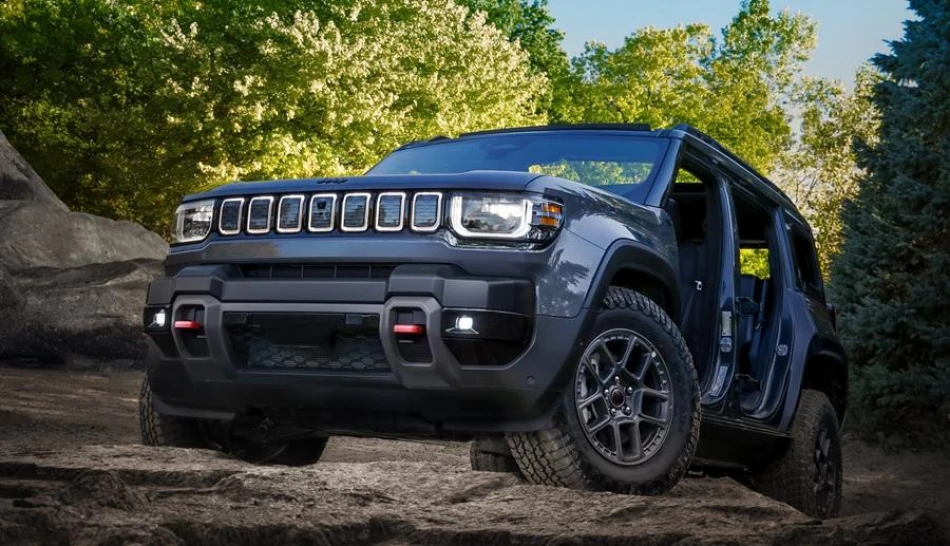
Jeep Unveils the All-Electric Recon: Revolutionizing the Future of 4x4 Mobility
 Omar Rahman
Jeep just announced pricing for its all-new electric Recon SUV at $65,000, marking a major step in the iconic off-road brand's push into electric vehicles. The Recon represents Jeep's attempt to prove that electric power can actually enhance off-road performance while maintaining the rugged character that made the Wrangler famous.
The 2026 Jeep Recon has been years in the making. Jeep first revealed the electric SUV concept in 2021, drawing clear inspiration from its legendary Wrangler. Production is set to begin early next year at a factory in Mexico.
The Recon keeps Jeep's signature boxy design along with removable doors, a rear spare tire, and an open roof - all the classic Wrangler features that off-road enthusiasts expect. But here's where it gets interesting: the electric motors deliver 650 horsepower and 620 lb-ft of torque, putting it in sports car territory.
"With the Jeep Recon, we're proving that electrification doesn't just work with off-road excellence - it elevates it," said Bob Broderdorf, Jeep's CEO. The instant torque and precise control that electric motors provide could actually make the Recon better at crawling over rocks and through mud than gas-powered alternatives.
But that power comes with trade-offs. The Recon's range tops out at 250 miles per charge, which is less than many cheaper electric vehicles on the market today. For comparison, Jeep's electric Wagoneer S offers 294 miles of range at nearly the same $65,200 price point.
The pricing puts the Recon about $14,000 above the 2025 Wrangler plug-in hybrid and $27,000 more than a basic four-door 2026 Wrangler. That's a significant premium for going fully electric.
This launch comes as Jeep tries to turn around years of declining sales. The brand hit its peak in 2018 with over 973,000 SUVs sold in the US, but sales have dropped 40% since then to under 590,000 units last year. Jeep has been cutting slower-selling models to focus on profitability rather than volume.
The Recon is the fourth and final new or updated product Jeep promised to reveal over four months. The others were a new hybrid Cherokee and redesigned versions of the Grand Cherokee and Grand Wagoneer.
The timing is challenging for any electric vehicle launch. Federal incentives worth up to $7,500 for plug-in electric vehicles ended in September, and EV sales have dropped sharply since then. Broderdorf acknowledged this will likely affect Recon sales but said he's not chasing volume just for the sake of it.
"I'm not going to pursue sales volume just to pursue sales volume," he said during a media call. "I want to sell vehicles the right way. Anyone who wants a battery electric Recon, I want to make sure we're going to be there for them."
The broader context matters here. Stellantis, Jeep's parent company, has significantly scaled back its electric vehicle investments over the past year following market changes and a CEO switch. Many automakers are slowing their EV rollouts as consumer demand hasn't met earlier projections.
Jeep will build the Recon at its Toluca, Mexico assembly plant alongside the Wagoneer S, Compass, and the new Cherokee hybrid. Broderdorf said the plant can easily adjust production between the Compass and Cherokee based on demand for electric versus gas-powered vehicles.
The company also plans to build both gas-powered models in the US in coming years for added flexibility. This hedge reflects the uncertainty many automakers face about how quickly consumers will actually adopt electric vehicles, especially without government incentives.
For Jeep, the Recon represents a critical test. The brand built its reputation on capable, affordable off-road vehicles. Now it's betting that customers will pay a premium for electric power and that the technology can actually improve the off-road experience rather than compromise it.