Germany Seeks Robust Capabilities to Bolster its Global Influence
 Sara Khaled
Germany faces a critical moment in its foreign policy approach. The country built its post-reunification influence on soft power and diplomacy, but that strategy is hitting limits in today's more confrontational world. Now Berlin needs to add military muscle to its diplomatic toolkit if it wants to stay relevant on the global stage.
Since reunification in 1990, Germany carved out a unique role in international relations. It focused on soft power and non-coercive influence, prioritizing cooperation, diplomacy, and economic ties over traditional hard power politics. Berlin saw itself as a civilian power that invested in diplomacy, development, and defense through regional and global institutions.
This approach worked well in the early post-Cold War decades. Germany became a leader in climate diplomacy and one of the world's largest providers of development aid. These liberal institutional tools helped establish Germany as a major economic and political force.
But success bred a certain moral superiority. Germany often presented its values as inherently good and superior, delivered with a heavy dose of righteousness. This worked when the world seemed to be moving toward German-style multilateralism.
Here's the problem: that world is disappearing. We're back in an era of great power competition. While civilian power remains valid - public goods still need providers and defenders working collectively - Germany's institutional approach needs harder, more realistic components to stay effective.
Other middle powers learned this lesson long ago. Britain and France balance soft and hard power naturally. But for German political elites and civil society, this shift requires a deep renegotiation of the values and interests underlying their foreign policy.
The war in Ukraine opened the door for real change. Former Chancellor Olaf Scholz called it a "Zeitenwende" - a turning point - in 2022. Germany finally started taking defense spending seriously.
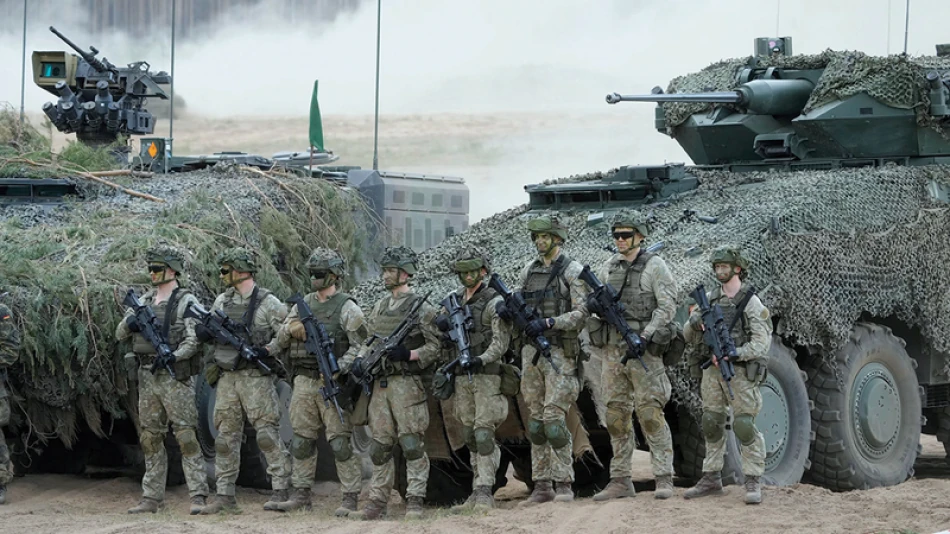
German defense investments now serve multiple purposes. They contribute to burden-sharing within NATO, allowing other allies to focus more on the Indo-Pacific region. They also send alliance signals, showing solidarity with regional NATO partners through a larger, if not more aggressive, German military presence.
Recent examples show this shift in action. The German frigate Baden-Württemberg crossed the Taiwan Strait in 2024. German airlift and paratroop units joined the 2025 Talisman Sabre exercises alongside Australia, the United States, and 16 other countries.
The German Navy will continue deploying ships to the Indo-Pacific, though this presence doesn't mean permanent positioning. Germany's military priority remains strengthening NATO's eastern flank through close cooperation with Poland, the Baltic states, and Scandinavian countries.
Despite its flaws, German defense policy represents a crucial milestone. It could reactivate German hard power not just in European and Atlantic frameworks, but globally. This might actually expand the reach of Germany's traditional soft power.
But this realistic rethinking needs a truly global perspective. Germany must redefine its alliances, supplementing traditional value-based partnerships within the G7 and other democratic frameworks with more pragmatic relationships with like-minded states in other regions, especially the Indo-Pacific where many international stakeholders are concentrated.
Germany can't offer cooperation frameworks like AUKUS, where the United States transfers nuclear submarine technology to Australia. But this new approach requires rethinking foreign policy tools and adopting a more realistic stance. This means redesigning development, science and technology, and arms export policies to offer more attractive cooperation in priority areas for partners.
Many of these lessons are already being integrated into broader strategic reviews by NATO and the European Union. The question is whether Germany can complete this transformation quickly enough to maintain its influence in a rapidly changing world.