Gates Foundation and Presidency Office Launch AI System to Boost Global Agricultural Development
 Layla Al Mansoori
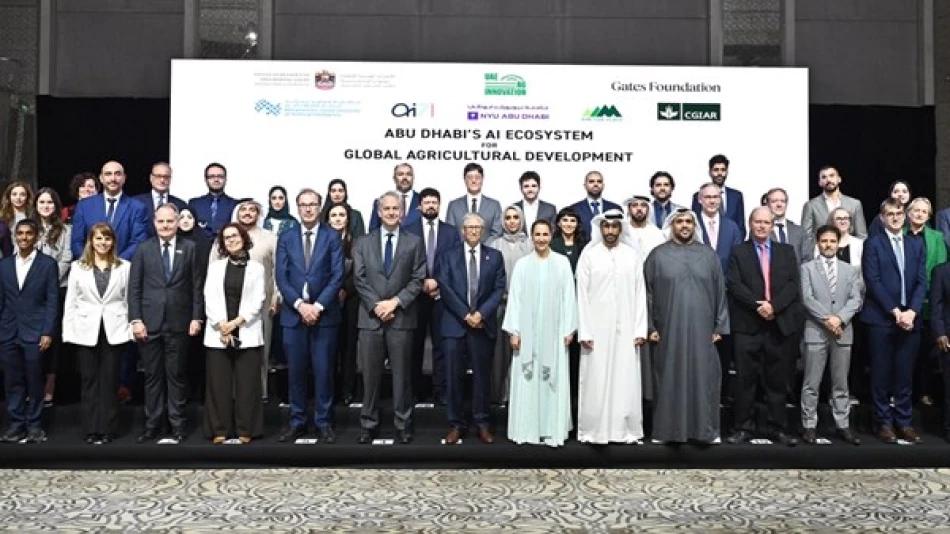
Abu Dhabi launched a new AI system designed to help farmers worldwide deal with climate change. The $200 million partnership with the Gates Foundation builds AI tools specifically for small-scale farmers who struggle most with unpredictable weather patterns and lack resources to adapt.
The system combines Abu Dhabi's growing AI expertise with global agricultural research. It brings together local institutions like Mohamed bin Zayed University of Artificial Intelligence, NYU Abu Dhabi, and AI company ai71, alongside international partners including the Gates Foundation and the World Bank.
Here's what makes this significant: Small farmers produce much of the world's food but have the least access to technology that could help them survive climate shocks. Traditional weather forecasting and agricultural advice often doesn't reach these communities or isn't tailored to their specific crops and conditions.
The partnership announced during COP28 focuses on four main components. The CGIAR AI Center will serve as a global platform hosted in Abu Dhabi, tapping into five decades of agricultural data from 13 research centers worldwide. The Institute for Agriculture and AI will provide digital consulting tools and training programs aimed at reaching over 43 million smallholder farmers.
The technical backbone includes AgriLLM, an open-source language model trained on 150,000 agricultural documents, 50,000 research papers, and 120,000 real farming questions and answers. The model works in multiple languages and provides region-specific advice on climate adaptation, resource management, and food production.
The fourth piece, AIM for Scale, focuses on scaling successful programs. India already uses the system to send AI-powered seasonal forecasts via text message to 38 million farmers. The program trained meteorological staff from Bangladesh, Chile, Ethiopia, Kenya, and Nigeria in Abu Dhabi, with plans to expand to 25 more countries by 2027.
Maryam Al Mehiri from the UAE's Presidential Office emphasized how the partnership converts research into practical solutions. "We're connecting our national capabilities in research and AI with global partners to transform scientific knowledge into applicable solutions on the ground," she said.
Bill Gates highlighted the urgent need: "Small landholders are among those most affected by climate change impacts, yet they don't have enough tools to adapt to new conditions." The system aims to change this by providing data-driven, practical solutions.
For global food security, this matters because climate change hits hardest where food systems are already most fragile. The initiative targets reaching 100 million farmers by 2030, potentially stabilizing food production in regions most vulnerable to weather extremes.
The approach reflects Abu Dhabi's broader strategy to become a hub for AI applications in critical global challenges. By hosting international research partnerships and developing open-source tools, the emirate positions itself at the center of efforts to apply AI to climate adaptation.