Colombian National Liberation Army Back in the Spotlight Amid Trump's Threats
 Sara Khaled
Colombia's National Liberation Army (ELN) has imposed a three-day curfew across cocaine-producing regions under its control, citing threats of "imperialist intervention" from President Donald Trump. The move escalates tensions as Trump deploys naval forces in the Caribbean and threatens military action against Latin American drug-producing nations.
The ELN announced the curfew will run from Sunday through Wednesday, restricting civilian movement while the group conducts what it calls defensive military exercises. This comes after Trump warned that cocaine-producing countries in Latin America could face attack, specifically targeting Colombia for "making cocaine" and "selling it to us."
Trump has backed up his rhetoric with action, positioning significant military assets in Caribbean waters off Venezuela's coast. The deployment targets Venezuelan President Nicolás Maduro's government, which Trump accuses of drug trafficking complicity.
The ELN, founded in 1964 and inspired by Argentine revolutionary Che Guevara, operates across more than 20% of Colombia's 1,100+ municipalities with roughly 5,800 members, according to InSight Crime research. The group controls key cocaine production areas, particularly the Catatumbo region along the Venezuelan border.
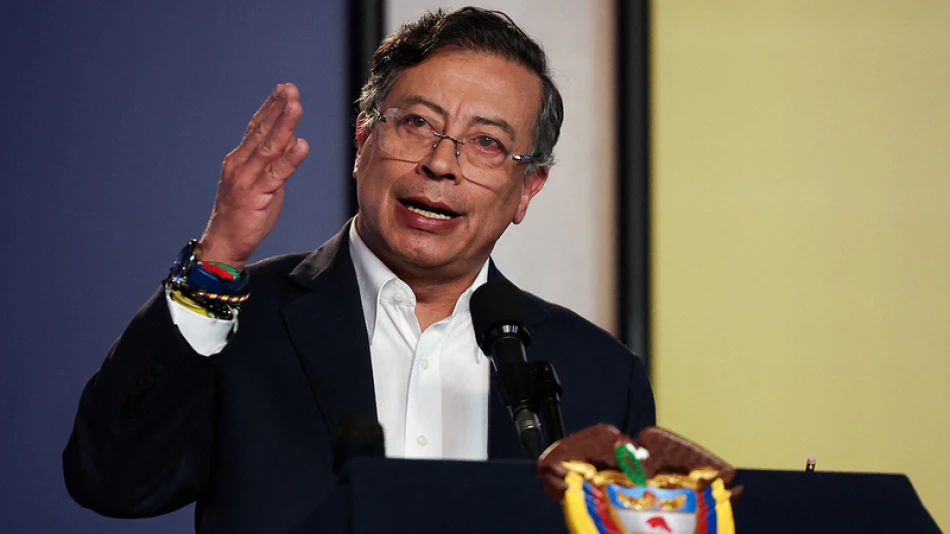
Colombian President Gustavo Petro, himself a leftist, sharply criticized the ELN's move. "Protesting anyone doesn't happen by killing peasants and stealing their freedom," he wrote on X. "Gentlemen of the ELN, you're calling for an armed strike not against Trump, but in service of the drug traffickers who control you."
Defense Minister Pedro Sánchez condemned the curfew as "criminal coercion" and warned that Colombian security forces "will be present everywhere, on every mountain, in every forest, and on every river."
The confrontation highlights Colombia's complex security landscape. The ELN remains the country's last major armed group after the Revolutionary Armed Forces of Colombia (FARC) disarmed and became a political party following a 2016 peace agreement. Peace talks between the ELN and Petro's government collapsed in January after two years of negotiations broke down over continued fighting.
Petro had previously warned Trump in early December to respect Colombia's sovereignty, writing that "attacking our sovereignty is tantamount to a declaration of war" and cautioning against destroying "two centuries of diplomatic relations."
The curfew puts civilians in ELN-controlled areas at the center of escalating geopolitical tensions. These communities, already caught between armed groups and state forces, now face restricted movement as the ELN positions itself as defending against foreign intervention while critics argue it's protecting drug trafficking operations that fund the organization.