Chinese Astronauts Return to Earth After Completing Taikonaut Mission at Tiangong Space Station
 Layla Al Mansoori
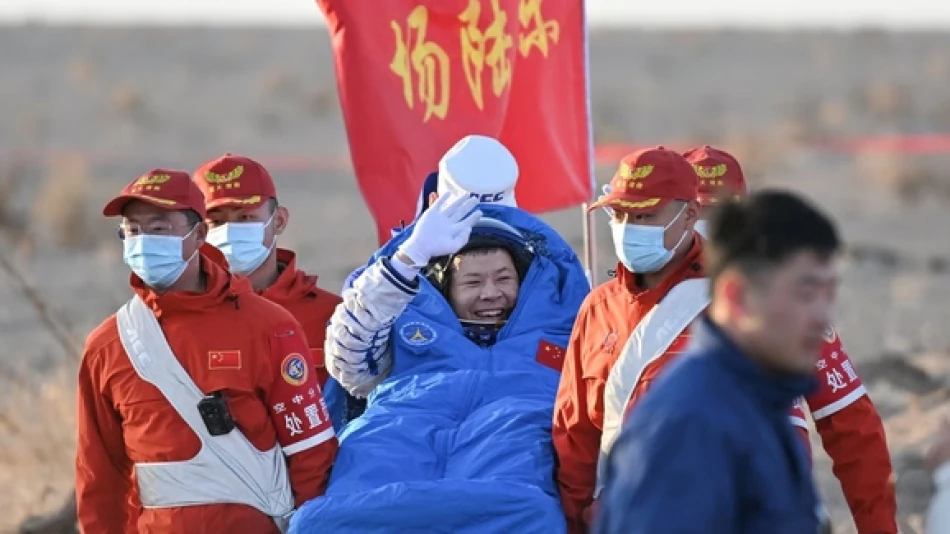
Three Chinese astronauts returned to Earth Friday after being stranded for days at China's Tiangong space station when microscopic space debris damaged their return capsule. The crew landed safely in Inner Mongolia after using a backup spacecraft, marking a rare setback for China's typically well-organized space program.
The astronauts were supposed to come home on November 5, but their Shenzhou-20 spacecraft got hit by tiny space debris while docked at the station. The impact created a thin crack in the capsule's window, making it unsafe for the dangerous journey back through Earth's atmosphere.
Chinese state television showed the moment their backup capsule touched down in the desert, suspended under a massive red and white parachute. The three men - Chen Dong (46), Chen Zhongrui (41), and Wang Jie (36) - landed at 4:40 PM local time and were confirmed to be in good health by China's Manned Space Agency.
Here's where it gets interesting: instead of risking their lives in the damaged capsule, the astronauts used the Shenzhou-21 spacecraft that was originally meant for their replacement crew. That crew had already arrived at the station in early November, so for several days, six astronauts were sharing the Tiangong station instead of the usual three.
This whole situation represents something unusual for China's space program. Beijing has built a reputation for precise planning and smooth operations in space. The country completed its Tiangong space station in 2022 and has been running regular crew rotations since then.
Space debris is becoming a real problem for everyone operating in orbit. Even tiny fragments can cause serious damage when they're traveling at thousands of miles per hour. The fact that microscopic debris could strand astronauts shows just how dangerous space is getting as more countries and companies put satellites and spacecraft up there.
The three astronauts who just returned had been at the space station since late April, completing a six-month mission. China's space agency said the next mission, Shenzhou-22, will launch at an unspecified date but didn't give any details about whether this incident will affect their schedule.
For China, this represents both a challenge and a success. The challenge is that space debris forced them to change plans and extend a mission. But the success is that they had backup options ready and got their astronauts home safely. That kind of redundancy is exactly what you need when you're operating hundreds of miles above Earth.