Azerbaijan and Armenia Move Closer to Signing Historic Peace Accord, Diplomat Reveals
 Layla Al Mansoori
Trump's South Caucasus Gambit: Azerbaijan-Armenia Peace Deal Could Reshape Strategic Energy Corridor
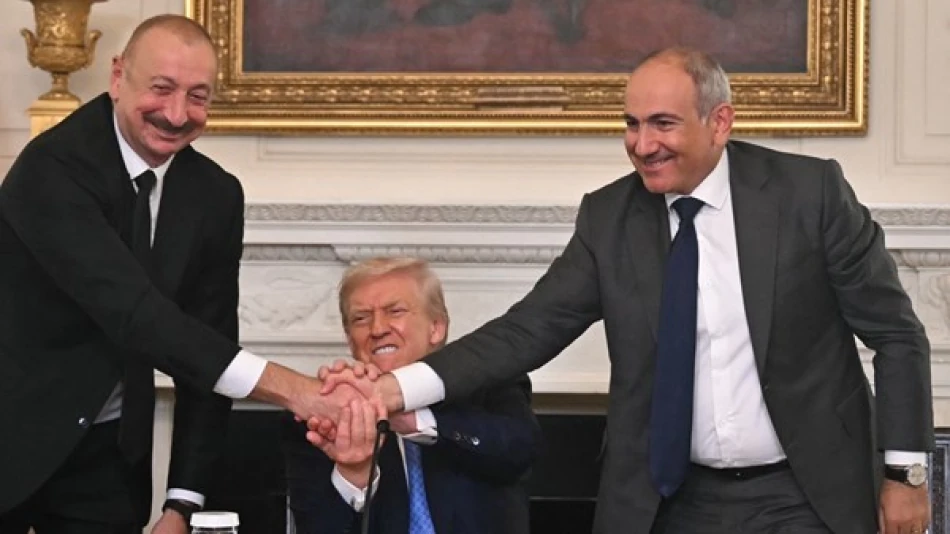
A decades-old conflict in one of the world's most strategically important energy transit zones appears closer to resolution than ever before. Following a White House meeting between President Trump, Azerbaijan's President Ilham Aliyev, and Armenian Prime Minister Nikol Pashinyan, senior Azerbaijani diplomat Elin Suleymanov declared that only one constitutional amendment stands between the two nations and a final peace agreement that could transform the South Caucasus into a major economic corridor.
The Final Hurdle: Armenia's Constitutional Challenge
According to Suleymanov, Azerbaijan's Ambassador to the United Kingdom and former envoy to Washington, the path to peace hinges on a single requirement: Armenia must amend its constitution to remove references to Nagorno-Karabakh, the mountainous region that sparked their conflict in the late 1980s.
"Azerbaijan is ready to sign at any time as soon as Armenia fulfills its basic commitment to remove its territorial claims against Azerbaijan from its constitution," Suleymanov stated, describing the current moment as a "qualitative leap" for the region.
The joint declaration signed at the White House represents the culmination of Azerbaijan's decisive 2023 military operation that restored full control over Nagorno-Karabakh, forcing approximately 100,000 remaining ethnic Armenians to flee to Armenia and effectively ending the territorial dispute.
Strategic Implications for Global Energy Markets
A permanent peace agreement would unlock significant economic potential in a region that serves as a crucial bridge between Europe and Asia. The South Caucasus hosts major energy infrastructure, including pipelines that carry Caspian oil and gas to European markets, making stability essential for energy security.
Transportation and Trade Corridors
Suleymanov emphasized that regional prosperity and transportation links would undergo "positive transformation" following a peace deal. This aligns with broader geopolitical trends as countries seek alternative trade routes amid global supply chain disruptions and shifting alliances.
The region's strategic location could position it as a key component of the Middle Corridor initiative, an alternative to traditional East-West trade routes that has gained momentum since 2022.
Trump's Diplomatic Approach: Pragmatic Deal-Making
The White House intervention reflects Trump's preference for direct, results-oriented diplomacy. Unlike previous mediation efforts by the European Union and Russia that focused on gradual confidence-building measures, Trump's approach appears designed to secure a definitive resolution.
This mirrors successful precedents from Trump's previous term, including the Abraham Accords that normalized relations between Israel and several Arab nations. The South Caucasus agreement could serve as another example of Trump's transactional diplomatic style producing concrete results where traditional approaches stalled.
Regional Power Dynamics and International Stakes
The timing of this diplomatic push carries particular significance given shifting regional alignments. Russia, traditionally a key mediator in South Caucasus disputes, has been preoccupied with its war in Ukraine, creating space for American diplomatic leadership.
Economic Integration Prospects
A peace agreement would likely accelerate economic integration between Azerbaijan and Armenia, potentially creating a more stable investment environment for international companies. Azerbaijan's substantial energy revenues could fund reconstruction and development projects that benefit both nations.
The resolution of this conflict would also remove a major obstacle to regional cooperation initiatives and could pave the way for normalized relations with Turkey, Armenia's neighbor that has maintained closed borders due to the Nagorno-Karabakh dispute.
Constitutional Politics and Domestic Challenges
While Suleymanov expressed confidence about Azerbaijan's readiness to finalize the agreement, Armenia faces the more complex domestic challenge of constitutional amendment. Such changes typically require parliamentary supermajorities and could face resistance from nationalist groups within Armenia.
However, the practical reality of Azerbaijan's military victory in 2023 may have created the political space necessary for Prime Minister Pashinyan to pursue constitutional changes that would have been politically impossible before the conflict's resolution.
The success or failure of this final diplomatic push will likely depend on whether Armenian leadership can frame constitutional amendments as pragmatic acceptance of new realities rather than capitulation, while positioning the peace agreement as an opportunity for economic development and regional integration.